Select food-grade mechanical seals from the complete hygienic duty, not from appearance or shaft size alone. Dairy and beverage pumps must control leakage while supporting cleanability, drainability, product quality, and documented food-contact suitability. The seal must also survive production, cleaning, sanitizing, and any steam cycle without creating avoidable product traps or contamination risks.
A white O-ring, blue elastomer, stainless-steel spring, or polished surface does not prove food-contact suitability. Verify the exact materials, compound grades, hygienic geometry, cleaning access, operating conditions, and supporting documents.
A Practical Food-Grade Seal Selection Process
- Identify the exact pump and installed seal arrangement.
- Define the product, concentration, temperature, viscosity, solids, and operating cycle.
- Record all CIP, SIP, rinse, detergent, acid, caustic, sanitizer, and steam conditions.
- Review hygienic geometry, drainability, product-contact surfaces, crevices, and cleanability.
- Select compatible face materials, elastomers, and wetted metals.
- Choose single, flushed, quenched, or double arrangement according to leakage, deposit, and containment risk.
- Confirm food-contact or hygiene documentation required by the buyer, plant, or market.
- Verify the replacement geometry and service-kit scope before release.
Why Hygienic Design Matters
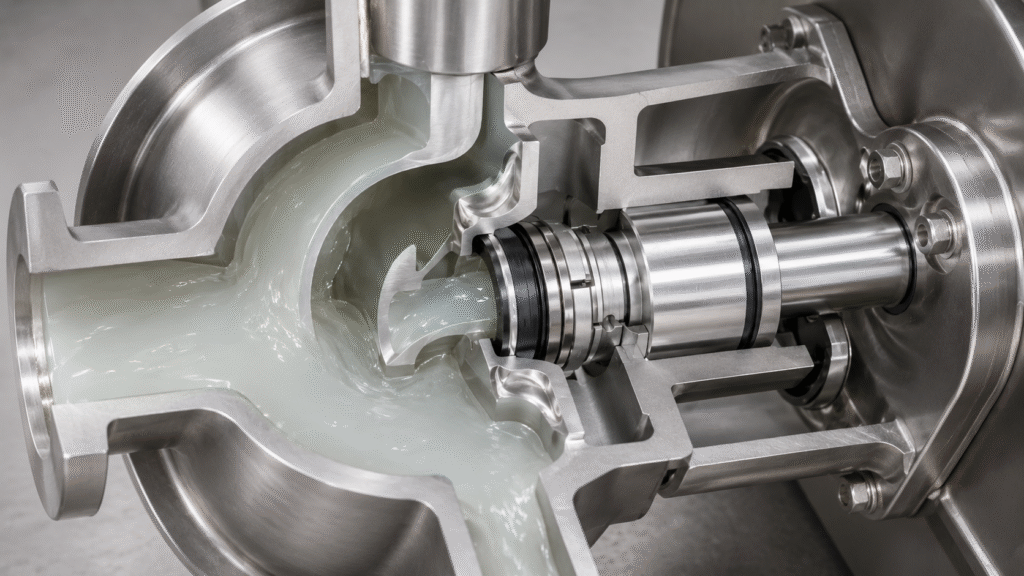
Food-grade material selection is only one part of hygienic performance. Product-contact geometry should avoid unnecessary crevices, dead spaces, difficult-to-clean recesses, and areas where product or cleaning fluid can remain trapped.
EHEDG guidance on hygienic mechanical seals and 3-A hygienic design guidance are useful references when a project requires formal hygienic design criteria.
CIP, SIP, and Cleaning Duty
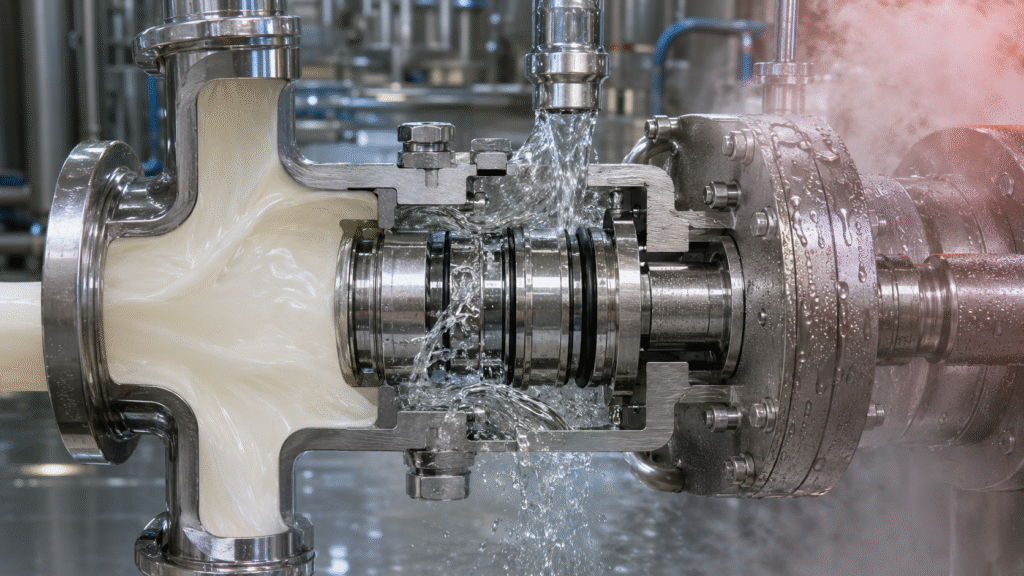
A seal can be compatible with the food product and still fail during cleaning. Record every cleaning chemical, concentration, temperature, contact time, rinse sequence, sanitizer, and steam condition that can reach the seal.
Cleaning cycles can expose elastomers and face materials to a more severe environment than normal production. Repeated hot/cold cycling can also affect elastomer compression, thermal expansion, and face stability.
Food-Contact Materials and Documentation
Face materials, elastomers, metals, and lubricants should be reviewed for the actual product and cleaning duty. The mechanical seal materials guide covers carbon, ceramic, silicon carbide, and tungsten carbide, while the mechanical seal elastomers guide covers NBR, EPDM, FKM, FFKM, and related secondary seals.
Documentation requirements vary by market, customer, and application. Where relevant, confirm the exact compound or component documentation instead of assuming a generic material family is automatically food grade.
For example, 21 CFR 177.2600 may be relevant to rubber articles intended for repeated food contact, but project requirements should be confirmed for the exact application and jurisdiction.
Seal Face Materials for Dairy and Beverage Pumps
Carbon, ceramic, and silicon carbide are common starting materials in sanitary and food-processing pump service. The correct pair depends on the product, lubrication, temperature, cleaning chemistry, and wear conditions.
- Carbon/ceramic: can be economical in suitable clean, well-lubricated duty.
- Carbon/SiC: may provide stronger wear and thermal performance in more demanding service.
- SiC/SiC: may be considered where abrasion, crystallization, or cleaning conditions justify hard/hard faces.
No face pairing should be selected only because it is described as sanitary or premium.
Elastomers for Food-Grade Mechanical Seals
EPDM, FKM, and other compounds are commonly considered in food and beverage equipment, but the exact grade must match both the product and the cleaning cycle.
- Product chemistry
- Oil or fat content
- Acid, caustic, detergent, and sanitizer exposure
- Normal and cleaning temperature
- Steam exposure where applicable
- Compression and dynamic movement
- Required food-contact or hygiene documentation
Do not identify an elastomer by color alone. A blue or white O-ring is not proof of compound identity or approval status.
Single, Flushed, or Double Mechanical Seal?
A single seal can suit clean products that provide stable face lubrication and do not create severe deposits. It also reduces support-system complexity. The decision still depends on leakage consequences, cleanability, viscosity, crystallization, and operating stability.
A flushed or quenched arrangement may help control atmospheric-side deposits or prevent sticky product from drying around the seal. The support liquid must be clean, compatible, controlled, and acceptable for the process.
Sticky products, crystallization, limited lubrication, containment needs, or selected aseptic duties may justify a double seal. “Food pump” does not automatically mean “double seal.” Barrier or buffer systems introduce additional fluid-quality, pressure, monitoring, and cleaning requirements.
The single vs double mechanical seals guide explains arrangement fundamentals in more detail.
Replacement Geometry and Cleanability
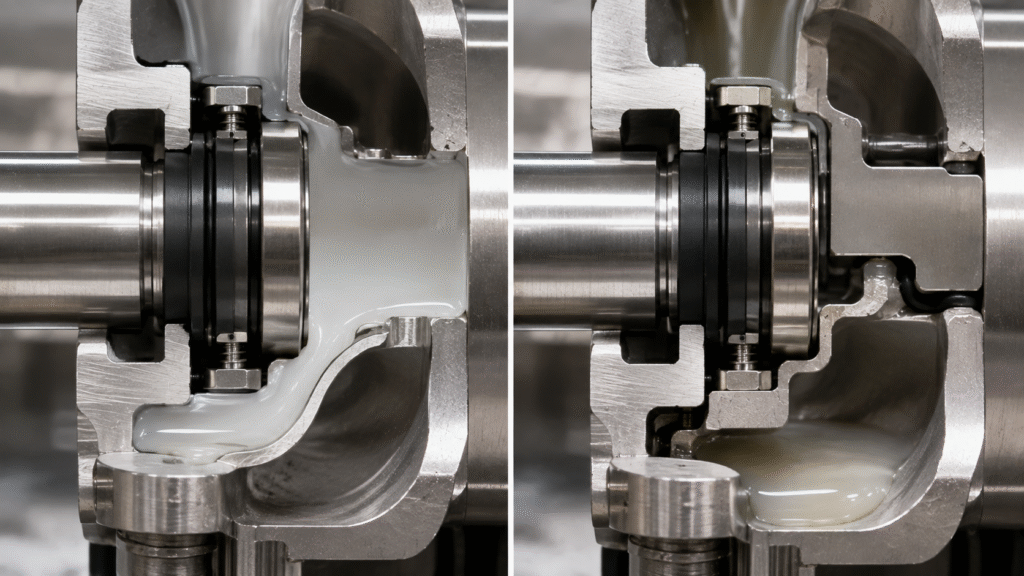
A replacement that fits the shaft can still change drainability, axial location, crevice geometry, or product-contact surfaces. Confirm the stationary seat, working length, gland or housing interface, elastomer locations, and any product-contact areas before release.
If the pump uses an existing service kit, confirm which static seals, gaskets, sleeves, or related components should be renewed with the mechanical seal.
Documentation to Confirm Before Ordering
- Pump manufacturer, model, and serial or article number
- Existing seal or service-kit reference
- Replacement drawing and critical dimensions
- Face-material specification
- Elastomer compound specification
- Wetted metal specification where relevant
- Food-contact or hygiene documentation required by the project
- CIP/SIP and cleaning conditions
- Inspection or traceability requirements
- Exact purchasing scope: seal only or complete service kit
Documentation should support an already compatible design. A certificate cannot make the wrong geometry or material technically suitable.
Common Food-Grade Mechanical Seal Selection Mistakes
- Assuming white or blue elastomers are automatically food grade
- Selecting by shaft size without checking hygienic geometry
- Checking the food product but ignoring CIP or SIP chemistry
- Using a “stainless steel” description without confirming the actual grade and wetted parts
- Choosing a double seal automatically without reviewing the support system
- Changing materials without checking cleanability or documentation requirements
- Comparing quotations without confirming whether they include the same service-kit components
Food-Grade Mechanical Seal Checklist
Before approving a replacement, confirm the pump, product, hygienic geometry, cleaning cycle, faces, elastomers, metals, seal arrangement, documentation, and replacement dimensions. This makes the selection a traceable hygienic-engineering decision rather than a simple material or size match.
For selected sanitary pump applications, Hong Teng also supplies APV pump mechanical seals. Compatibility must be confirmed against the exact pump and operating duty.