Mechanical seal materials strongly affect pump reliability in wastewater and slurry service. The faces must resist abrasion, while elastomers and metal parts must tolerate the liquid, temperature, contamination, and cleaning chemicals.
For many wastewater pumps and fine abrasive slurries, silicon carbide against silicon carbide is a strong starting point. Tungsten carbide may deserve consideration when large particles, vibration, impact, or heavy mechanical loading increase the risk of chipping. No single material combination is correct for every sewage or slurry pump.
The mechanical seal material selection guide explains why the complete duty must be reviewed before a material specification is approved.
A Practical Selection Process for Wastewater and Slurry Service
- Identify the exact pump and existing seal arrangement.
- Define every liquid that can reach the seal.
- Record solids concentration, size, hardness, shape, and settling tendency.
- Check shaft, bearings, alignment, vibration, and cavitation.
- Select the face pair from abrasion, impact, corrosion, lubrication, and heat requirements.
- Select elastomers and wetted metals for the actual chemistry and temperature.
- Confirm seal-chamber design, flush, barrier fluid, oil chamber, and other support conditions.
- Compare the proposed replacement with the previous failure pattern before ordering.
Define the Actual Wastewater or Slurry Duty
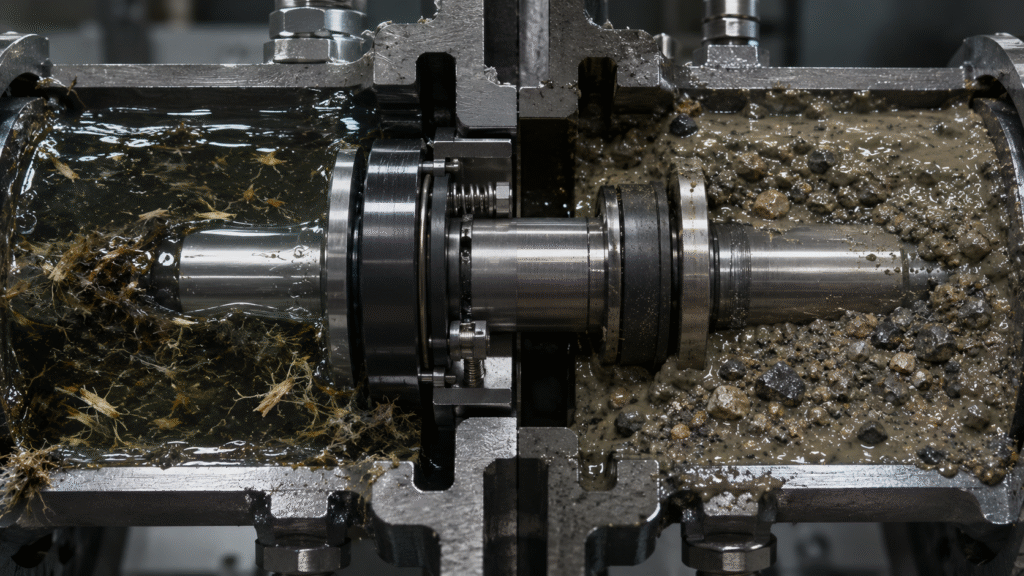
Do not describe the application only as “dirty water” or “slurry.” Municipal sewage with soft fibers creates different material and seal-design demands from silica slurry, mineral tailings, or a corrosive slurry containing fine crystals.
Before selecting materials, record:
- Complete pump model and serial number
- Mechanical seal type, position, and dimensions
- Single, double, tandem, or oil-chamber arrangement
- Normal and maximum seal-chamber pressure
- Normal and maximum temperature
- Shaft speed
- Exact liquid composition and pH where relevant
- Chlorides, chemicals, oil, solvents, or hydrocarbon contamination
- Solids concentration, size, hardness, shape, and specific gravity
- Settling and crystallization tendency
- Cleaning chemicals
- Flush, barrier, or oil-chamber fluid details
- Previous seal life and failure pattern
How Solids Damage Mechanical Seals
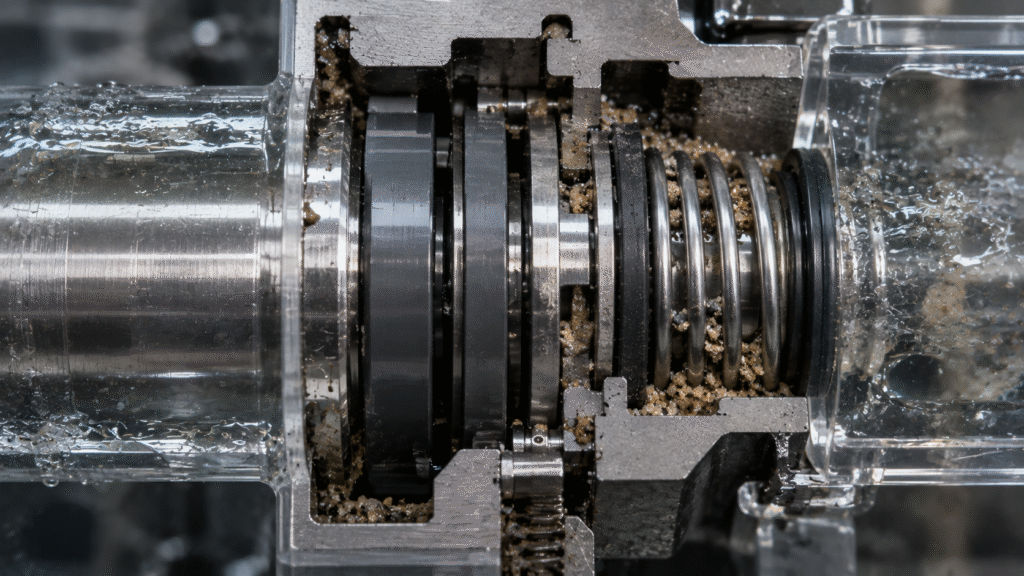
Solids can damage a mechanical seal in several ways. Fine abrasive particles can enter the face interface and increase wear. Fibers and deposits can restrict moving components. Large particles may create impact or chip brittle faces. Settling solids can pack around springs or prevent a secondary seal from moving during startup.
Material hardness therefore matters, but seal design matters too. Large clearances, protected springs, flushing, oil chambers, and double-seal arrangements may be more important than a small difference between two hard-face grades.
Silicon Carbide vs Tungsten Carbide
Both silicon carbide and tungsten carbide can perform well in abrasive service.
Silicon carbide is often a strong starting point for fine particles, abrasive wastewater, and corrosive liquid because of its hardness, wear resistance, and broad chemical capability in suitable grades.
Tungsten carbide can provide an advantage when abrasion occurs together with impact, vibration, coarse solids, or heavy mechanical loading. Binder chemistry must still be checked for corrosion resistance.
The detailed silicon carbide vs tungsten carbide comparison explains hardness, toughness, corrosion resistance, and thermal behavior in more detail.
Some seals use SiC/TC pairings to balance wear resistance and toughness. The face combination, loading, and operating limits should be approved for the specific seal design.
Mechanical Seal Materials for Wastewater Pumps
Municipal Sewage and Drainage
For product-side seals exposed to sewage, sand, and fibers, SiC/SiC faces are a common starting direction. NBR, EPDM, or FKM may be selected according to the actual liquid. Stainless or higher-alloy metal parts should be chosen according to corrosion conditions rather than by a universal grade rule.
Submersible pumps may use an oil chamber and upper/lower seal arrangement specified by the pump manufacturer. Do not assume both positions require identical materials.
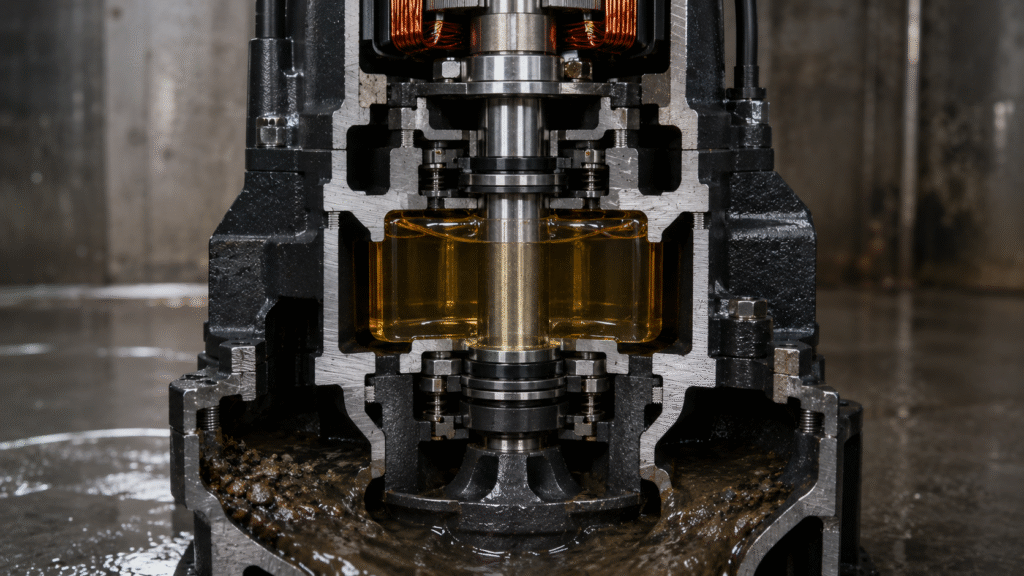
For related replacement examples, see the Flygt replacement mechanical seals category. Compatibility must still be confirmed against the exact pump and existing seal.
Fibrous Wastewater
Fibers can wrap around springs, retainers, or exposed drive features. A hard face alone cannot prevent this failure. Protected components, seal-chamber geometry, and the ability to clear deposits can be as important as the face pair.
Mechanical Seal Materials for Slurry Pumps
Fine Abrasive Slurry
Fine hard particles can accelerate face wear. SiC/SiC is a common starting direction when chemistry and lubrication support it. Review the solids concentration and whether the slurry remains suspended at the seal faces.
Coarse or Impacting Solids
Coarse particles, vibration, and impact increase mechanical severity. Tungsten-carbide-based pairings or another approved tough hard-face arrangement may deserve consideration. A mechanically tough material still cannot correct excessive shaft movement.
If vibration or shaft movement is present, inspect shaft runout and misalignment and pump cavitation and vibration before relying on a material upgrade.
Slurry That Settles During Shutdown
Heavy solids can settle inside the seal chamber when the pump stops. Small clearances or exposed springs may become packed with solids, preventing the seal from moving correctly at restart.
For severe settling or slurry service, seal construction, support system, and solids exclusion can matter more than choosing between two similar hard-face grades. Slurry-focused designs may use large clearances, protected components, or double-seal arrangements.
Elastomers for Wastewater and Slurry Service
| Elastomer | Common Strengths | Important Limitations |
|---|---|---|
| NBR | General water service, mineral oils, good cost control | Limited ozone, high-temperature, and chemical resistance |
| HNBR | Improved heat and mechanical performance over standard NBR | Compatibility still depends on the exact compound and liquid |
| EPDM | Water, hot water, many dilute acids, alkalis, and oxidizing media | Normally unsuitable for petroleum oils and hydrocarbon fuels |
| FKM | Many oils, fuels, and chemical duties | Not universal for steam, amines, ketones, or all wastewater chemistry |
| FFKM | Very broad chemical capability in selected compounds | High cost; exact grade still requires verification |
Use the mechanical seal elastomers guide for compound-level selection. Do not identify elastomers by color alone.
Metals and Seal-Support Systems
Springs, sleeves, retainers, drive pins, glands, and fasteners must tolerate the liquid and any cleaning or flush chemistry. Hard faces do not protect weak springs, incompatible O-rings, corroding retainers, or a damaged sleeve.
Support-system condition can also determine seal life. Poor flushing, contaminated barrier fluid, incorrect oil, or wrong pressure can damage premium materials. Double-seal or oil-chamber arrangements should follow the pump or seal manufacturer’s requirements rather than a generic filling rule.
External examples of slurry and wastewater seal systems include John Crane slurry seal documentation and dual-seal wastewater pump documentation.
Step-by-Step Material Selection Checklist
- Complete pump model and serial number
- Seal type, dimensions, position, and working length
- Face arrangement
- Normal and maximum pressure and temperature
- Shaft speed
- Exact liquid composition, pH, and chlorides where relevant
- Solids concentration, size, hardness, shape, and settling tendency
- Oil, solvent, or hydrocarbon contamination
- Cleaning chemicals
- Elastomer compatibility
- Metal corrosion resistance
- Seal-chamber design
- Flush, oil, or barrier-fluid requirements
- Shaft, bearing, alignment, and vibration condition
- Previous seal life and failure pattern
If the original seal identity is uncertain, use the mechanical seal identification guide. For general face-material properties, see the mechanical seal materials guide.
Common Selection Mistakes
- Choosing the hardest face without defining the solids problem
- Ignoring tungsten carbide binder chemistry
- Treating every silicon carbide grade as identical
- Selecting elastomers by color
- Ignoring cleaning chemicals
- Upgrading only the faces while leaving weak elastomers or metals unchanged
- Ignoring flush, barrier, or oil-chamber condition
- Using another pump’s material specification without checking the actual duty
The best wastewater mechanical seal materials are those matched to the real solids, chemistry, lubrication, pump condition, seal design, and support system. Material upgrades should solve a defined wear, corrosion, or mechanical problem rather than simply increase hardness or cost.